The summer slowdown is behind us. Vacations are logged, the out-of-offices are off, and what’s left of 2026 is a sprint that runs straight into your 2027 plan.
Before you put your head down, it’s worth pausing for one uncomfortable exercise.
Verne Harnish’s Scaling Up methodology rests on four pillars: People, Strategy, Execution, and Cash. Simple to name. Harder to balance.
Here’s the question for you and your leadership team. Not the aspirational answer, the real one.
What percentage of your time last quarter went into each of the four?
How about the leadership team, same question.
Write it down. Have each member of your team write it down separately. You could make four slices on a pie chart, with time and percentage applied to each pillar.
Then compare. I’ve never seen a team where those numbers matched, and the gaps are where the conversation gets useful.
People are the pillar that never closes.
Most teams discover their time is lopsided toward People, and there’s a reason for that. People are never finished. You get the seat right, and six months later the seat has changed. You’ve got C players to move up or move out and “or out” – half most leaders defer for a quarter longer than they should. You’ve got A players who need to be told, out loud and specifically, what they did well. Culture is caught not taught. And you’ve got a whole middle tier of B players who need someone to name where they are today and what the next level looks like.
That work is legitimate. It’s the engine. But it’s also infinitely absorbing. It will take every hour you hand it, and it feels productive while it does. Which is precisely why the pillar that quietly starves is Strategy.
Strategy doesn’t ask for your time, so you must give it.
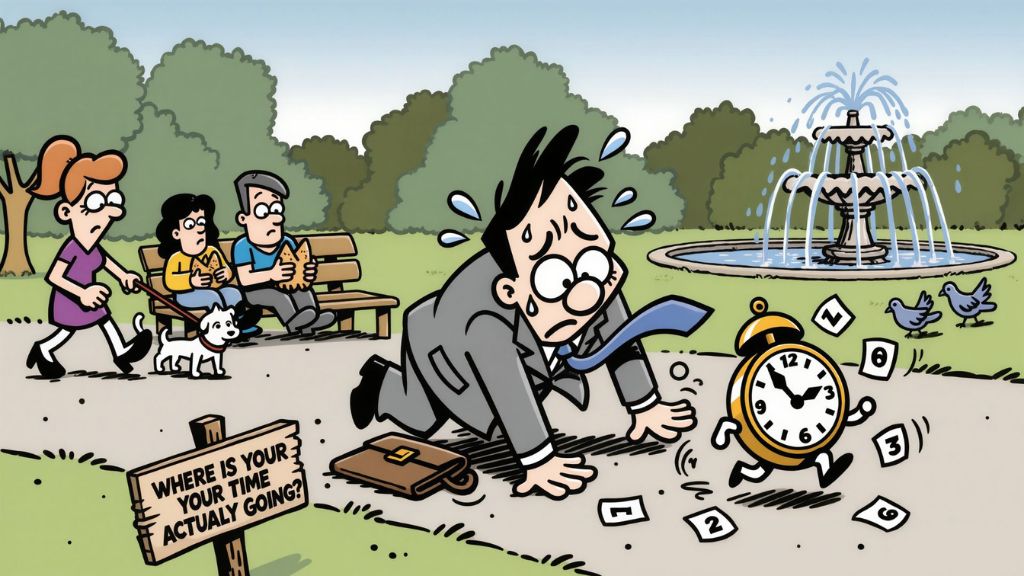
Nothing on your calendar shows up labeled “strategy.” No one escalates a strategy emergency. It doesn’t text you at 10 p.m. Therefore, it gets the leftovers, an offsite once a year, a rush hour before the board deck is due.
If Strategy is getting single digits of your time, you’re not steering. You’re reacting fast and calling it leadership.
But quantity is only half of it. The harder question is quality. How rigorously do you interrogate your own answers?
Try these four on your next strategic decision:
- Run a premortem. Before you approve the product, the service line, or the new pricing, put the team in a room and say “It’s twelve months from now and this failed badly. What killed it?” People who won’t voice doubt in a go/no-go meeting will hand you the exact failure mode when you give them permission to imagine it already happened. Foreshadow the failure while it’s still cheap!
- Hunt your confirmation bias. You already have a preferred answer. Everyone in the room knows what it is. Does the data that supports it get waved through and the data that contradicts it gets a cross-examination? Assign someone to argue the opposite case and mean it and make sure it’s someone whose bonus doesn’t depend on winning the argument. Consider forming an internal debate club.
- Watch the silence. In every leadership meeting there is someone not talking who should be screaming. It’s usually the person closest to the customer, the plant floor, or the code. They’ve done the math in their heads and decided the room isn’t going to change course, so why spend the capital? Silence isn’t consent. Call on them by name, and do it before you take the vote, not after.
- Decide what you’re saying no to. Strategy without subtraction is a wish list. If the plan doesn’t kill something, it isn’t a plan.
The ask
Before your Q4 planning session, ask every member of your team for their four pillar percentage split, blind. Bring the spread to the meeting. That gap between what you thought you were doing and what you did is your first strategic conversation of 2027.
Strategic planning should not be accidental, it should be intentional!