
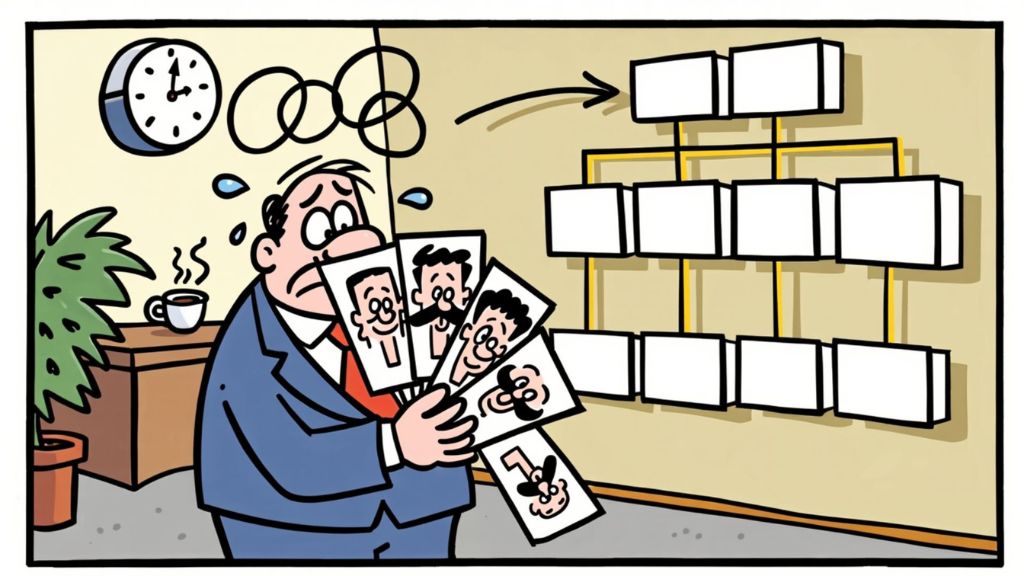
Every quarter, I ask my CEO clients to do something that sounds simple and almost never is, draw your current org chart.
It’s easy in the sense that everyone knows who reports to whom. But when we put it on paper, a pattern shows up almost every time. The founder or CEO sits in three or four boxes at once running sales, approving every hire, still the de facto head of product. The VP of Ops is quietly covering finance because nobody’s gotten around to hiring a controller. Talented people are stretched across roles that were never meant to be theirs long-term, and the company has simply adapted around the gaps.
That’s Org Chart Current. It’s a snapshot of triage, not design.
Then I ask the harder question. What does your org chart look like in two years, if the business hits the goals, you say you want to hit? That’s Org Chart Future, and it’s rarely a bigger version of today’s chart. It’s a different shape entirely. Roles split apart. New seats appear. And increasingly, some of those seats aren’t held by people at all.
A while back, I started referring to all teammates and contractors, be they onshore or offshore, as teammates. Under this line of thinking, additional members of your team have roles such as CPA, outside legal counsel, insurance broker, executive coach, or coaching organization. Why not put them on the org chart, current or future, as well? After all, they are teammates.
I’ve started asking clients a question that would have sounded like science fiction three years ago. Are the “people” on your org chart human beings, or are they human beings and AI agents, or both?
Under Verne Harnish’s framework for scaling a business, it comes down to four things, people, strategy, execution, and cash. AI isn’t replacing that framework, it enhances it. The question could be posed, is “people” now human beings and AI agents? I think yes!
I’m working with CEOs who have named their AI agents along with actual defined responsibilities, sitting on the org chart next to teammates such as their controller and their head of marketing. One agent owns first-pass customer support triage. Another owns weekly financial reporting drafts. They have a “manager,” they have a scope of work, and they have a line on the chart just like anyone else.
That might sound like a gimmick. It isn’t. Naming the agent and giving it a real seat forces the same discipline you’d apply to any hire. What outcome is this seat accountable for? Who manages it? What happens when it underperforms? CEOs who skip that discipline end up with AI sprawled across the business with no owner and no accountability, which is just a more expensive version of the founder-in-four-boxes problem.
Here’s the exercise I’d give you this week. Draw your Org Chart Current. Be honest about where you or your leaders are covering three jobs. Then draw Org Chart Future, not just the human seats you’ll need, but the agent seats too, named, and accountable.
The gap between those two charts is your hiring plan, your development plan, and increasingly, your AI strategy, all in one page.